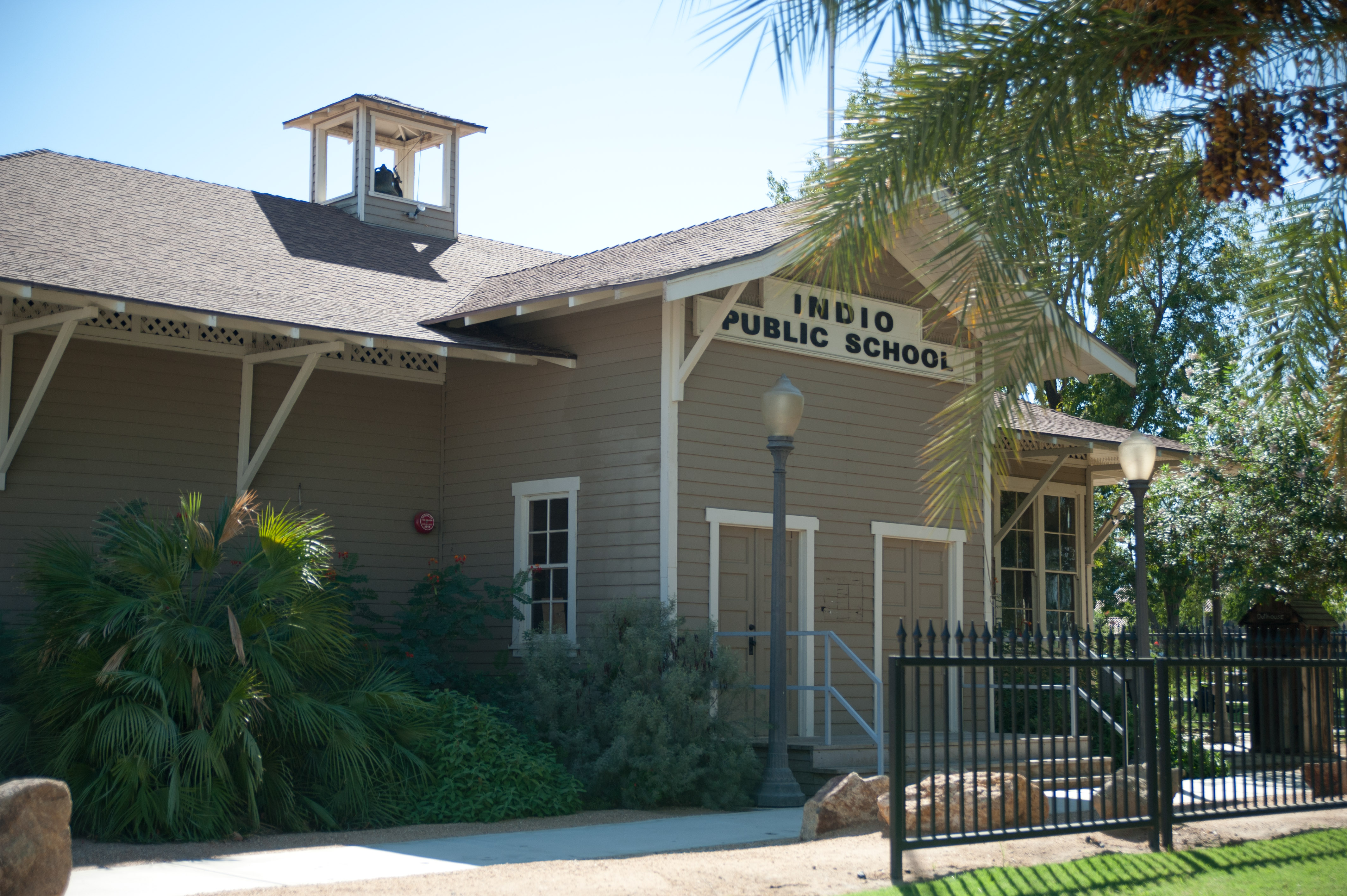
In 1909 the adobe school was replaced by a frame, two-room school house located on school district property at the corner of Oasis and Bliss streets. The bell from the adobe school was moved to the new frame building. George Koehler, a longtime Indio resident remembers ringing the bell. He was the bell ringer in 1918 and told that the bell rope had knots placed at intervals to accommodate the various heights of students whose privilege it was to ring the school bell. The bell was rung at 8:30 am and again at 1 pm to call the children to school. It was also used to announce special school events, such as parties and plays. He also recalled that the bell was rung when the Armistice was declared November 11, 1918, signaling the end of World War I. Also, he mentioned that the bell was silent during the great Spanish Influenza epidemic 1918-19 when many people were stricken. School was closed and the school house used as a hospital to care for the sick.
On June 10, 1926, a contract was let to T. C. Kistner & Company in the amount of $22,000 to construct a four room hollow tile building to replace the frame school. The new school was later named the Lincoln School.. It remained in use for many years until the property was sold and the building was demolished sometime after 1955. The old frame school was moved to a site behind the Roosevelt School on Highway 111 and served as extra classroom space for Roosevelt School students, as a school cafeteria and later for a storeroom.
At first the Lincoln School was used for all eight grades. Among the early teachers were Lucy Laflin, Carmen Cook, wife of County Supervisor, Bill Cook, Aileen Underwood Walker, and Ione Crabb Cologne. Mrs. Cologne had come to the valley to teach in the Ensign School in 1916-17, took a job in Oxnard for a year, then returned to the valley to marry Knox Cologne in 1918. She spent the next decade raising their sons, Knox Jr. and Gordon, then resumed her teaching career in 1928 at Lincoln School. Teachers at that time received $1,350 yearly.
For a number of years Lincoln School had served as a school for students in grades one through four who needed help in learning English. School Board Minutes of October 15, 1931 said, "Permission was granted Mrs. Ione Cologne to purchase dishes and cooking utensils to prepare and serve food to the undernourished Mexican children of Lincoln. She had reported that the teachers of that building had agreed to finance and carry on the work until the PTA was in a position to relieve them..." Then, in 1942, a ruling against segregation of Mexican children was made and those children with limited English were no longer sent to separate schools.
In time the school became known as "Mrs. Cologne's School." Parents would do almost anything to get their children enrolled in Mrs. Cologne's first grade class. When she retired in 1957, Indio declared "Ione Cologne Day" and more than 400 people turned out to help her celebrate. She stayed at Lincoln School until it was declared unsafe by the state and was closed in 1952, having served as teacher and principal. She spent her last five years teaching first grade at Hoover School.
In a 1966 article in the Press Enterprise, Rex Nevins tells of teacher's State School Registers that go back to 1916. They reveal that Frank Cavanaugh was six years old and in the first grade on September 17, 1916. Aurora Tebo was nine and in the fourth grade and Martha Shamblin was nine and in the fifth grade on October 20, 1918. George Koehler, 11, was a fifth-grader as was Arthur Cavanaugh, who was 12. Ralph Pawley was 10 and in the fourth grade.
In the same article, Mr. Nevins records that early school board members included Dr. Francis Purcell, Ted Johnston, Curt Newman, Cliff Gentry, Edward Shannon, Ward Grant and Bert Cavanaugh. The latter was a rancher in the Indian Wells area and a member of the original Point Happy School Board.
The Periscope, a series available on Amazon:
The Periscope includes a series of engaging publications that detail the rich history of the Coachella Valley. From life as a pioneer, the growth of the date industry, all the way to the Salton Sea saga, and much more, the stories bring to life the desert region of Southern California. Written under the umbrella of the Coachella Valley Historical Society (dba Coachella Valley History Museum), books in the series tell the stories of the innovators who helped to make the vibrant region what it is today.
ABOUT THE AUTHORS
Dr. Priscilla Porter is the Co-Director of the Porter History-Social Science Resource Center at the Palm Desert Campus of California State University San Bernardino and a volunteer at the Coachella Valley History Museum. A former elementary school teacher, she is the author of many popular curriculum guides for teachers.
Professional gratitude is extended to the contributing authors: Patricia Korzec, Renee Brown, Diana P. Kitagawa, Rod Hendry, Julia Sizek, and Patricia Laflin. Credit is extended to Eduardo Contreras for the cover design.
This is the first book in The Periscope series from the Coachella Valley Historical Society (dba Coachella Valley History Museum). Additional books in the series will be available SOON. To hear about the latest books, sign up for the exclusive New Release Mailing List by sending an email to prisporter@aol.com. You’ll be glad you did!
Requesting Your Review – Reviews are very important to authors. If you’ve enjoyed this book, please write a review of it on www.Amazon.com