Often women have had to fight or go against the social norms of the day to dream the impossible, and, through their grit, they have made things happen. The Periscope is devoted to the women who have braved the heat and dust in the forlorn desert outpost of the Coachella Valley region of California right up to the women of today who continue to brave the unknown in their pursuit of a better life for all who live here. These are the women who work hard to do good things. These are the women we honor.
by Diana Kitagawa and Rod Hendry
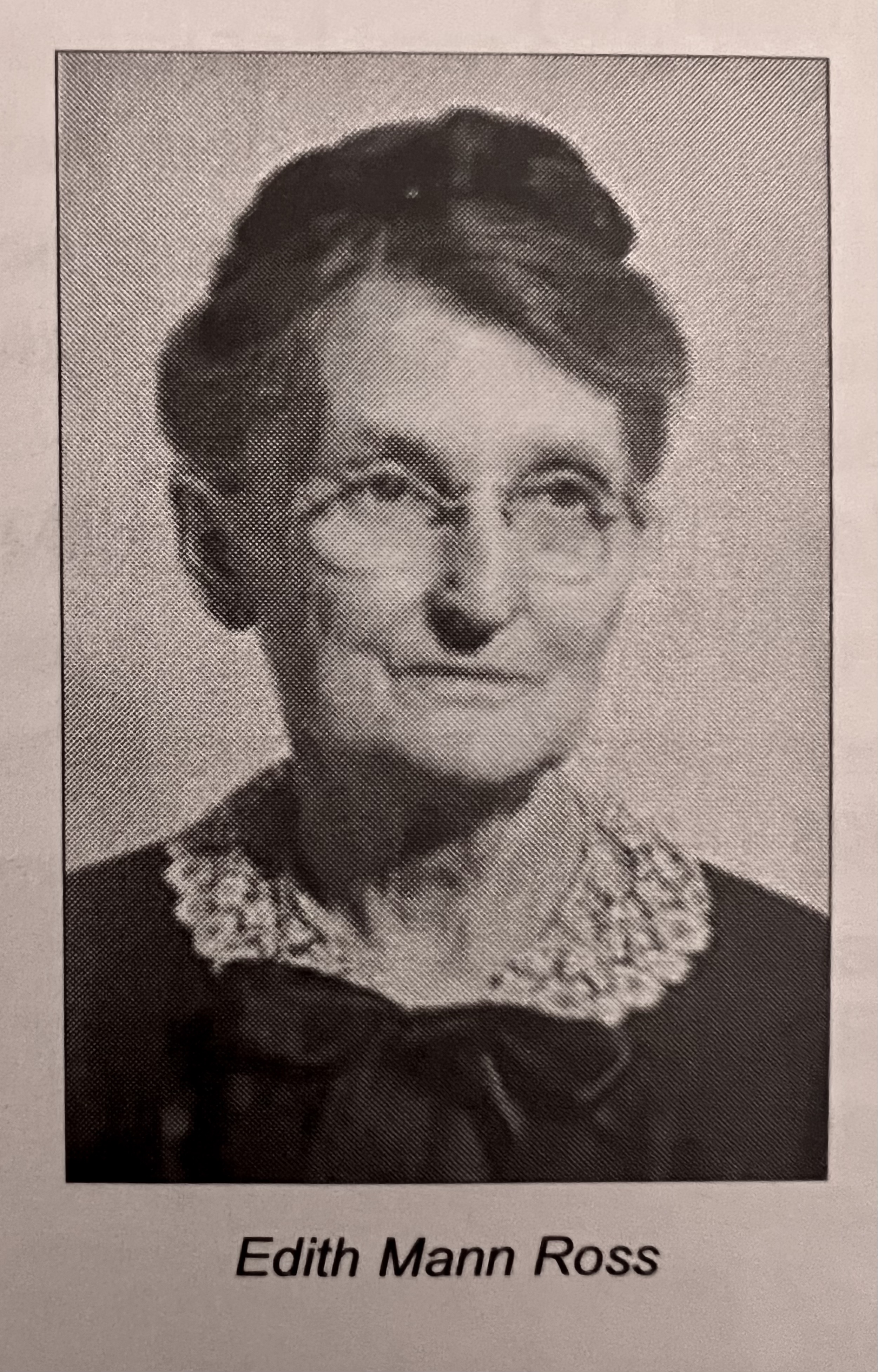
Edith Mann Ross, "The First Lady of Indio," embodies the fortitude of the early pioneers of the Coachella Valley. During one interview, she was described as, "Ramrod straight she sits, her strong pioneer heritage reflecting strength, courage, and determination."
Edith's father, Sylvester Allen Mann, was a Methodist minister. She had a sister and two brothers. To provide relief for her mother's asthma, in 1896, the family made a seven-month trek of 1,035 miles in a covered wagon from Vancouver, Washington to the drier climate of San Bernardino, California. For parts of the trip, Edith remembered walking beside the wagon. After living in San Bernardino for two years, the family moved to Indio.
Edith's father, who was the first minister in Indio, would conduct church services out of the schoolhouse. He purchased two lots from Albert Tingman, and they settled down in a three- room palm frond house. "Actually, there was nothing more than sagebrush, mesquite trees, rattlesnakes and coyotes," Edith recollected.
In 1901, when Edith was 16 years-old, she married Bailey Ross, a switch engine engineer for the Southern Pacific Railroad. They had two daughters, Lillian and Georgia.
Edith and Bailey were enticed by the amount of money being made growing cantaloupes. He did the planting and irrigating, while she ran the gas engine on the little pump. Although they were the most delicious melons, the Rosses, unfortunately, ended with $40 of debt ($1,169 in today's dollars).
Electricity didn't come to the valley until 1912. Once the Rosses built their own home on Jackson Street, Bailey bought Edith a Victor Gramophone-the first mechanical music-maker in the valley.
Though the early years were shrouded in hardship, the social aspect of the railroad made life more bearable, even enjoyable. The end of the railroad station as the center of society was quite a setback for Edith. She recalled in one interview, "We had such good times in that place. It was the country club, the night club, the recreation center, and the town's favorite restaurant." The vibrancy and centrality of the railroad stations was a unique, memorable era.
In 1920, Bailey lost his railroad job when the union went on strike. The Rosses decided to leave the valley. Bailey ran the stationary engines in the oil fields near Huntington Beach and San Fernando. Unfortunately, difficult times, unemployment, and health problems brought the Rosses back to the valley. After Bailey died in 1942, Edith worked in restaurants and dry- cleaning until she retired. On July 3, 1976, Mrs. Ross was honored as "Indio's First Lady." She passed away on July 20, 1982.
The following poem, written by Edith, attests to her own acceptance and appreciation of life.
Memories are all that is left
Of the days of long ago,
Memories dear to the heart
That only oneself may know.
Memories of golden hours,
Memories of sorrow and pain,
Some are like sunshine and flowers,
Some are like storm clouds and rain.
Some are so fond and precious
Regard them with zealous care;
Too tender, sweet and sacred
To fall upon other ear.
And when the golden sun has settled,
Slipped away in the rose-tinted west;
When day into twilight has faded,
My memories escort me to rest.
The Periscope, a series available on Amazon:
The Periscope includes a series of engaging publications that detail the rich history of the Coachella Valley. From life as a pioneer, the growth of the date industry, all the way to the Salton Sea saga, and much more, the stories bring to life the desert region of Southern California. Written under the umbrella of the Coachella Valley Historical Society (dba Coachella Valley History Museum), books in the series tell the stories of the innovators who helped to make the vibrant region what it is today.
ABOUT THE AUTHORS
Dr. Priscilla Porter is the Co-Director of the Porter History-Social Science Resource Center at the Palm Desert Campus of California State University San Bernardino and a volunteer at the Coachella Valley History Museum. A former elementary school teacher, she is the author of many popular curriculum guides for teachers.
Professional gratitude is extended to the contributing authors: Patricia Korzec, Renee Brown, Diana P. Kitagawa, Rod Hendry, Julia Sizek, and Patricia Laflin. Credit is extended to Eduardo Contreras for the cover design.
This is the first book in The Periscope series from the Coachella Valley Historical Society (dba Coachella Valley History Museum). Additional books in the series will be available SOON. To hear about the latest books, sign up for the exclusive New Release Mailing List by sending an email to prisporter@aol.com. You’ll be glad you did!
Requesting Your Review – Reviews are very important to authors. If you’ve enjoyed this book, please write a review of it on www.Amazon.com