.png)
by Julia Sizek*
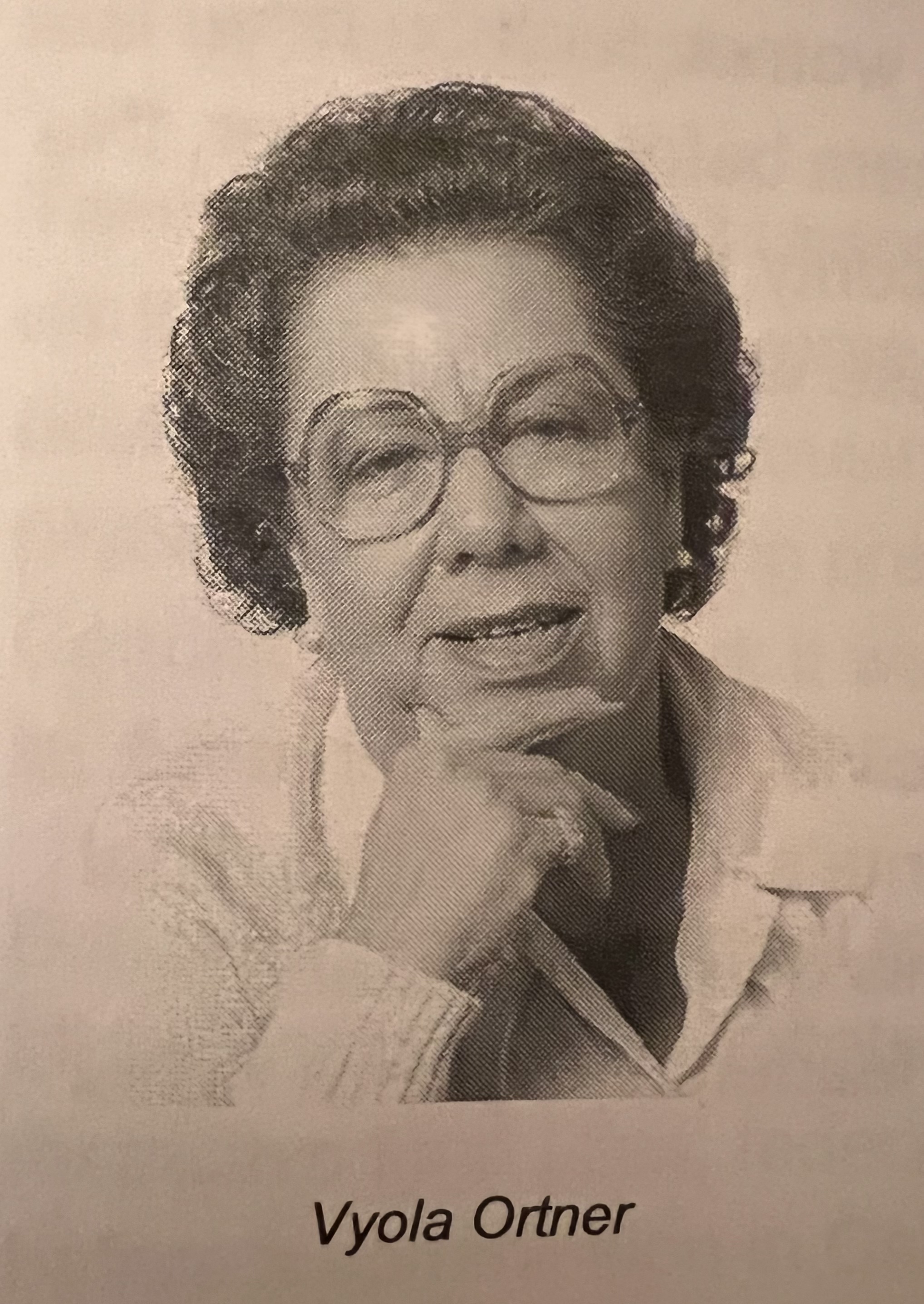
Her ninety-five years encompassed nearly a century of dramatic changes in Palm Springs, which is at the center of her tribe's past and present territory. When she was born, Palm Springs was a country backwater that was only just beginning to become a resort; by her death, the town had cemented that reputation.
Vyola not only witnessed these changes but made them herself. As chairman of the Agua Caliente tribe, she negotiated with city leaders and testified in the U. S. Congress. She did this among fellow women as part of the tribe's-and the country's-first all-woman council. The first council was elected in 1954, with Vyola as chairman, Eileen Miguel as Vice-Chair, LaVerne Saubel as Secretary, Flora Patencio, and Elizabeth Pete Monk. This was followed by several successive years of fully female councils that included the above women as well as Gloria Gillette, Dora Joyce Prieto, and Priscilla Gonzales. Under their tenure, Agua Caliente's tribal lands underwent dramatic transformations from the barren backside of Palm Springs to a new place for business investment, including the spa that made Agua Caliente's hot springs a tourist destination starting in 1960.
Their story is that of Palm Springs today-a story of real estate and inequality, of developers and workers, of haves and have-nots.
When these women entered the tribal chambers, Palm Springs was contending with the legacies of World War II. During the war, Palm Springs became an army town. Soldiers and civilians alike flooded the town to work in war industries. Like other lower- and middle-class Palm Springs residents, their biggest challenge was finding a place to live. Palm Springs' housing boom, which had lasted even through the Great Depression, was almost entirely for wealthy residents. Unable to find traditional housing, many workers turned to living on tribal lands in tents or small houses on short-term leases. Because these lands were long neglected for upkeep from the city of Palm Springs or the Bureau of Indian Affairs (BIA), many of these residents had little access to water, gas, or electricity. While there was no public-sector support to solve these infrastructure problems, there weren't private-sector solutions either-the BIA mandated five-year lease maximums that dissuaded private investors and made bank loans impossible. These 640 acres, known as Section 14, were seen as an eyesore to Palm Springs elite, in danger of ruining the resort town's elite status.
But WWII was not only a time of changes to housing and industry in Palm Springs, but a time of social transformation across the country. During much of the war, women took on new roles working alongside men in industries that had been closed to them before. However, this was not a real equality-women were paid less and had less job security than men-and many women were forced out of the workforce after the war. But these working women began to set a new precedent: women behaving boldly.
When Vyola Olinger was first elected to Agua Caliente's tribal council in 1952, she entered one of these traditionally male roles. Just a year earlier, Agua Caliente's last net, or spiritual and ceremonial leader, Albert Patencio, died. Following his death, his descendants and inheritors of the net role decided to discontinue the traditional tribal leadership system rather than continue it in a compromised form.
This opened traditionally male leadership roles to women during one of the most pivotal times in Agua Caliente's modern history. Not only did the tribe decide how tribal governance would work after the Patencio's death,' but they also had to solve the problems that returned after the war. These problems were all tied up in their land.
While some tribes across the country had their lands allotted to individual members beginning in the late 1800s, Agua Caliente had deep divisions between tribal members as to whether this was a good idea for the tribe. Allotments were also made more difficult technically because of the high value of tribal lands near downtown Palm Springs- differences in land value made it harder to apportion equally valuable parcels. As a result, allotments were not really settled officially until the 1950s. However, about half of the tribal members took allotments before they were officially approved, like Olinger's family.
Like other Native American tribes, Agua Caliente's land is held in trust for them by the Federal Government. This special status meant that their land was protected from being sold to unscrupulous developers or stuck in unfair long-term leases, but also made it hard for the land-rich and capital-poor tribal members to lease their land or develop businesses. A couple of enterprising tribal members-including Vyola Olinger's mother, Juana Hatchitt-built cabins or tents for rent on lands unofficially designated for individual tribal members, turning small profits on year-long or month-long leases. For the most part, tribal members didn't benefit from leases on communally held lands since the tribally owned tourism at the hot springs in Section 14 or the Indian Canyons on the southern tip of Palm Springs were only a small source of income.
Since the 1920s, Palm Springs boosters had been looking for ways to get a hold on Indian lands. They imagined the Indian Canyons as a National Park that drew tourists to Palm Springs for its scenic beauty and stands of California fan palms (Washingtonia filifera).
Their designs for Section 14 would evict current residents and open tribal lands for sale to real estate developers.
Their opinions didn't change by the 1950s; if anything, boosters found the housing situation on Section 14 to be worse. Though the growing tourism economy required workers and housing, the lack of housing had reached a crisis point. Workers turned to Section 14 for a place to live-redlining prevented them from living in Palm Springs if lack of capital didn't. Conditions worsened: it was not unusual for fifty families to share a 3/4-inch water main-that is, if they had access to water at all.
Boosters proposed tribal termination as a solution. After the passage of HCR 108 in 1953, tribes could lose their status as federally recognized tribes, which would mean an end to restrictive land titles, federal welfare programs, and tribal sovereignty. At a 1954 hearing before a commission in California, Vyola Olinger testified against prominent Palm Springs businessmen, testifying that an end to trust status would worsen the already predatory business relationships that Agua Caliente members endured.
Zachary Pitts, a local developer and a representative for the City of Palm Springs, testified on the other side. He argued that keeping Agua Caliente's land in trust status was detrimental to Palm Springs' tax income, though he failed to mention how local businesspeople would like to purchase these lands after a hypothetical termination.
Ultimately, the commission found termination to be unworkable, largely due to the estimated cost of passing welfare rolls and other management responsibilities onto the state. Though Agua Caliente could celebrate a temporary victory, winning against termination only maintained their old problems.
The next goal of the all-woman council was to find a way to successfully lease tribal lands for periods longer than five years. After heated debate and public opposition from prominent Palm Springs businesspeople, Public Law 255 was passed in 1955 through Congress, which allowed 25-year leases (with one renewal) to be set on tribal lands. Though this lease length was still not long enough for most banks to support loans, it gave hope to the tribal council, who hired nationally renowned planner Victor Gruen to make them a land-use plan for Section 14.
This law also renewed the vigor of Palm Springs elite to find a way to control Indian lands. The newest strategy was to support a bill that would create a corporation to manage tribal lands. This group, composed equally of city officials, BIA bureaucrats, and tribal members, would give tribal members a minority in making their own land use plan. The next representative to the House of Representatives, presumably Republican Jackie Cochran (famed aviator and wife of Floyd Odlum), would introduce this at the beginning of the 1957 legislative session. In a surprise victory, Democrat Dalip Saund won the 1956 House election with grassroots support of Imperial and Riverside County farmworkers. When given the bill to examine, he declared it objectionable because it seemed to give over not only management, but full title to the proposed corporations' white majority.
Saund insisted on public hearings in Palm Springs before he could agree to introduce the bill. At these public hearings, Olinger presented a counterplan that would keep some lands-the Indian Canyons and the hot springs-communally held and allot other lands to individuals. A version of this plan, eventually backed by the City and tribal members, was passed as HR 13323 in 1958. Just a year later, another bill allowed long-term leases of 99 years on tribal lands, a legislative victory for Olinger and the Agua Caliente's All-Woman Tribal Council that made economic development on the reservation actually feasible.
In 1959, Vyola Olinger retired from the tribal council to spend more time with her family. The challenges of her time were far from over-Agua Caliente spent much of the following years arguing with the city about zoning and contending with court-appointed guardians for tribal members deemed incompetent-but her job was done.
The Periscope, a series available on Amazon:
The Periscope includes a series of engaging publications that detail the rich history of the Coachella Valley. From life as a pioneer, the growth of the date industry, all the way to the Salton Sea saga, and much more, the stories bring to life the desert region of Southern California. Written under the umbrella of the Coachella Valley Historical Society (dba Coachella Valley History Museum), books in the series tell the stories of the innovators who helped to make the vibrant region what it is today.
ABOUT THE AUTHORS
Dr. Priscilla Porter is the Co-Director of the Porter History-Social Science Resource Center at the Palm Desert Campus of California State University San Bernardino and a volunteer at the Coachella Valley History Museum. A former elementary school teacher, she is the author of many popular curriculum guides for teachers.
Professional gratitude is extended to the contributing authors: Patricia Korzec, Renee Brown, Diana P. Kitagawa, Rod Hendry, Julia Sizek, and Patricia Laflin. Credit is extended to Eduardo Contreras for the cover design.
This is the first book in The Periscope series from the Coachella Valley Historical Society (dba Coachella Valley History Museum). Additional books in the series will be available SOON. To hear about the latest books, sign up for the exclusive New Release Mailing List by sending an email to prisporter@aol.com. You’ll be glad you did!
Requesting Your Review – Reviews are very important to authors. If you’ve enjoyed this book, please write a review of it on www.Amazon.com