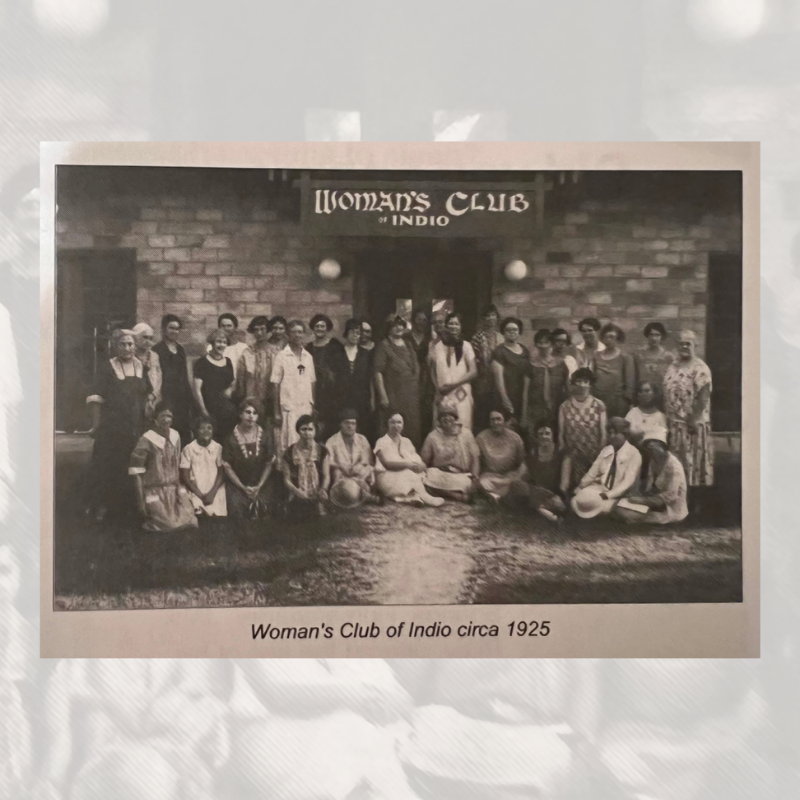
In 1912 when Indio was a dusty little desert town, a small group of pioneer women, the majority of whom lived on isolated ranches, felt the need for social interaction and the companionship of other women. They called themselves the Altrurian Literary Club. Today, known as the Woman's Club of Indio, they meet on the first Wednesday of each month at 11:30 a.m. at Heritage Palms Country Club.
Besides the Woman's Club of Indio, there are four other woman's clubs in the Coachella Valley. Each one is an active charitible organization that raises funds for many worthwhile causes in the Coachella Valley. These clubs include:
Unfortunately, the Woman's Club of Coachella Valley, organized in 1924, no longer exists. Due to dwindling membership, they ceased to operate in April 2000. At their demise, members gave $50,000 to the Coachella Valley Historical Society for the renovation of the 1909 schoolhouse now locted on the campus of the Coachella Valley History Museum.
Elizabeth Moore, often referred to as the "Mother of Indio," said, "The early homesteaders battled continuously against burros, coyotes, jackrabbits, and wild cattle. It was a constant warfare against all of them, and you could hear the noise of shotguns from every homestead. We used to relish the rabbits for stew. But the burros were the greatest nuisance... One morning we awoke, and burros were everywhere - in my garden, in the barn, and on top of the bale pile! The homestead became a noisy, dusty place until we had those tramps out into the desert. And every day or so, with dust flying, we'd take the offensive until we got rid of them (The 1992 Periscope, p. 19-20).
Ethel Rouse rode a burro during her early teaching days in what is now Desert Hot Springs. Homesteader, Jack Riley, offered the use of his desert dugout - the subterranean room where he lived while building his house.
Parents upgraded the dugout into a "classroom," adding walls, a door, one window, and shutters. Insects dropped from the thatched roof onto the sand floor. Rouses recalled, “Eventually we did get some money with which to buy a flag, a floor, and desks and a 4-foot-by-6-foot blackboard, but until then, in teaching my first graders to write, they used the clean sand of the floor for paper and their fingers for pencils, and by using pebbles in the sand they learned addition and subtraction" (Jamie Shoop Bray, The Desert Sun, Sept. 7, 1993, B1).
Mrs. Lois Wood came to the Valley in August 1914 with her husband and two sisters. "We females joined the Woman's Club of Indio, a group of pioneer women who, living in this harsh land without close neighbors and with few of the comforts and conveniences, took matters into their own hands and did something about the situation" (The 2012 Periscope, p.5). Lois served as president of the Woman's Club of Indio for two terms. She also helped organize the Library District and was on the first Library Board, she served as secretary of the Chamber of Commerce, was a member of the Gnat Abatement Board; and, during World War II, she was a member of the Ration Board.
lona McKenzie worked throughout the Valley promoting the need of a Valley-wide public cemetery. In August 1927, the Coachella Valley Cemetery District was approved by the voters.
The Periscope, a series available on Amazon:
The Periscope includes a series of engaging publications that detail the rich history of the Coachella Valley. From life as a pioneer, the growth of the date industry, all the way to the Salton Sea saga, and much more, the stories bring to life the desert region of Southern California. Written under the umbrella of the Coachella Valley Historical Society (dba Coachella Valley History Museum), books in the series tell the stories of the innovators who helped to make the vibrant region what it is today.
ABOUT THE AUTHORS
Dr. Priscilla Porter is the Co-Director of the Porter History-Social Science Resource Center at the Palm Desert Campus of California State University San Bernardino and a volunteer at the Coachella Valley History Museum. A former elementary school teacher, she is the author of many popular curriculum guides for teachers.
Professional gratitude is extended to the contributing authors: Patricia Korzec, Renee Brown, Diana P. Kitagawa, Rod Hendry, Julia Sizek, and Patricia Laflin. Credit is extended to Eduardo Contreras for the cover design.
This is the first book in The Periscope series from the Coachella Valley Historical Society (dba Coachella Valley History Museum). Additional books in the series will be available SOON. To hear about the latest books, sign up for the exclusive New Release Mailing List by sending an email to prisporter@aol.com. You’ll be glad you did!
Requesting Your Review – Reviews are very important to authors. If you’ve enjoyed this book, please write a review of it on www.Amazon.com